


Thursday, September 2016
Ernst Fehr – “The Brain’s Functional Network Architecture Reveals Human Motives”
Goal-directed human behaviors are driven by motives. Motives are, however, purely mental constructs that are not directly observable. Here, we show that the brain’s functional network architecture captures information that predicts different motives behind the same altruistic act with high accuracy. In contrast, mere activity in these regions contains no information about motives. Empathy-based altruism is primarily characterized by a positive connectivity from the anterior cingulate cortex (ACC) to the anterior insula (AI), whereas reciprocity-based altruism additionally invokes strong positive…
Find out more »Thursday, October 2016
Jan Drugowitsch, “Normative Decisions Between More than Two Alternatives”
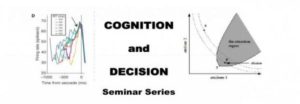
Every-day decisions frequently require choosing among multiple alternatives. Compared to binary choice paradigms, much less is known about the computational principle of decisions with more than two options. Previous physiological and behavioral experiments have revealed puzzling properties of human/animal decisions involving more than two options, such as interactions among these options and time-dependent decision thresholds. Why the nervous system ought to have such properties and how they functionally relate to each other remains poorly understood. To address these problems, we have derived the normative strategies for general value-based decisions…
Find out more »Jan Drugowitsch – “Normative Decisions Between More than Two Alternatives”
Every-day decisions frequently require choosing among multiple alternatives. Compared to binary choice paradigms, much less is known about the computational principle of decisions with more than two options. Previous physiological and behavioral experiments have revealed puzzling properties of human/animal decisions involving more than two options, such as interactions among these options and time-dependent decision thresholds. Why the nervous system ought to have such properties and how they functionally relate to each other remains poorly understood. To address these problems, we…
Find out more »The Rise and Implications of the 1099 Economy

A Panel Discussion Featuring Susan Houseman, W.E. Upjohn Institute Alan Krueger, Princeton University Robert Solow, Massachusetts Institute of Technology David Weil, Department of Labor Moderated by Eric Verhoogen, Columbia University The nature of work arrangements is changing in the U.S. and other countries. More and more workers are employed as independent contractors and freelancers (receiving 1099 tax forms), often “on-demand” and organized through digital platforms like Uber, Taskrabbit and others. What is behind this trend? What are the implications for…
Find out more »Thursday, November 2016
The 9th Kenneth J. Arrow Lecture
Credit Surfaces, Leverage Cycles, and Doom Loops Delivered by John Geanakoplos, James Tobin Professor Economics, Yale University The American financial crisis of 2007-09 and the ensuing Great Recession proved that macroeconomic and financial booms and busts can be driven by credit conditions like leverage. The European crisis of 2010-2012 showed that they can also involve a feedback between sovereign debt, corporate debt, and bank debt. Geanakoplos will present a collateral general equilibrium model of credit, default and macroeconomic activity, and…
Find out more »1022 International Affairs Building (IAB)

1022 International Affairs Building (IAB)
Mail Code 3308
420 West 118th Street
New York, NY 10027