

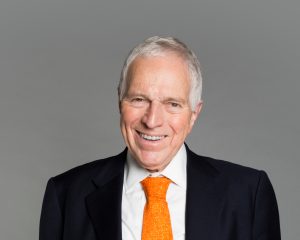
 The Department of Economics mourns the passing of Edmund “Ned” Phelps, the 2006 Nobel Prize of Economics, who was the McVickar Professor of Political Economy at Columbia until his retirement in 2022. Ned Phelps has had an extraordinary impact on modern economics in a wide range of areas. At the end of the 1960s, he launched a research program that sought to rebuild Keynesian macroeconomic theory on microeconomic foundations, emphasizing the behavior of firms and households operating under imperfect information and pervasive market frictions. His work has fundamentally changed our understanding of the relationship between inflation and unemployment, and thereby the analysis of monetary and fiscal policy.
Among his many original concepts and models that changed the field, one can mention the “natural rate of unemployment” and the “expectations-augmented Phillips curve” relation between unemployment and inflation; the “island” parable of search unemployment; “efficiency wage” models of the labor market; the “customer market” model of pricing by firms; “New Keynesian” models of inflation and unemployment dynamics that combined nominal rigidities with the hypothesis of rational expectations; the “golden rule” for optimal capital accumulation; early work on the implications for economic dynamics of time-inconsistent preferences; and an influential model of statistical discrimination. Many of these ideas have been extensively developed in the further work of later scholars, and have become central tools of modern economic analysis.
Phelps earned his BA from Amherst College (1955) and his PhD from Yale (1959). He joined the Economics faculty at Columbia University in 1971 as Professor of Economics after having previously served on the faculties of Yale University and the University of Pennsylvania. Aside from a year spent at NYU in 1978-79, Phelps served as a Columbia faculty member for over 50 years, becoming the McVickar Professor of Political Economy in 1983. In 2001, Phelps founded the Center on Capitalism and Society at Columbia. He transitioned into emeritus status in January 2022. During his career, Phelps contributed 24 books to the field of economics, either as author or editor. These include the pathbreaking Microeconomic Foundations of Employment and Inflation Theory (1970), which became known as the “Phelps volume”; Structural Slumps (1994), Rewarding Work (1997), and Mass Flourishing (2013), and over 180 articles in journals, books, and conference volumes. In 2023, he published My Journeys in Economic Theory, which charted his role in reshaping economic theory over his long and rewarding career.
Phelps was the recipient of many honors, awards, and fellowships, most notably the Nobel Prize in Economics, which he was awarded in 2006 “for his analysis of intertemporal tradeoffs in macroeconomic policy”. Phelps’ contributions to economics were further recognized throughout the world; he was named a Chevalier of the National Order of the Légion d’Honneur by the government of France in 2009, he received the Mendeleev Medal for Achievement in Sciences by the Russian Academy of Sciences in 2012 and the Chinese Government’s Friendship Award in 2015, and in 2017 was named an Academician of Honor by the Royal European Academy of Doctors, among others. By the end of his academic career, Phelps had been awarded honorary doctorates at 11 institutions and honorary professorships at 7 institutions in the United States and around the world.
Ned has also contributed immensely to the intellectual life of Columbia through his stewardship of the Center on Capitalism and Society, which he founded in 2002 and directed until 2024. Through its conferences and its journal, Capitalism and Society, the Center did much to stimulate interdisciplinary discussion of the conditions under which the dynamism of modern economies could be maintained, and to connect economics with broader currents of social thought.
The faculty, students, and staff of the Department of Economics and all of Columbia University are saddened by Phelps’s passing. “Ned had an outstanding impact on macroeconomic thought”, said Department Chair Bernard Salanié. “His towering intellect and lively wit will be sorely missed”.
