

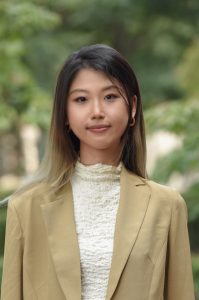
Where are you from?
I’m from Shenyang, northeast of China.
What sparked your interest in Economics, and what led you to pursue your M.A. at Columbia?
I knew I wanted to continue studying economics after college. As part of an economics podcast club with master’s and PhD students at Bocconi University, I had the chance to explore different areas of the field — from environmental economics to the gig economy. There were so many fascinating topics that I often felt there was still much more to learn. At the same time, I wasn’t completely sure about my specific research interests or whether I wanted to pursue a PhD right away. That’s why I think the MAE program at Columbia is a great fit for students like me who are deciding between academia and industry. It opens doors in both directions, and I’m sure you’ll discover your own path during this one-and-a-half-year journey.
Can you tell us a bit about what you’re doing now?
I’m currently working as an analyst at an economic consulting firm called Econ One Research. I just had my first company gathering in LA last week and another group retreat in Colorado over the summer — both were really fun experiences! It’s an employee-owned firm, and I really appreciate being surrounded by people who share similar values and goals. Most of my work focuses on claims data cleaning and processing, research, and analysis in the healthcare industry. I help the expert prepare economic reports for antitrust and reimbursement cases.
How did your experience at Columbia shape your academic or professional path?
My time at Columbia really deepened my interest in economic consulting and helped me turn that interest into a real career path. I first learned about the industry during my undergraduate studies and thought it might be a great fit for my skills and curiosity, but I didn’t have the chance to explore it in depth then. At Columbia, I connected with several MAE alumni already working in economic consulting. Through coffee chats and their advice, I learned more about the day-to-day work and began preparing for my summer internship applications. My internship at another consulting firm reinforced my interest — it was exactly what I expected, combining data analysis with economic theory.
And it wasn’t just about the work; it was also about the people. I met so many amazing classmates in my cohort. In fact, I joined my current company because one of my classmates, who had also interviewed there, recommended it to me after accepting another offer at an AI firm. He told me they were great people and that it would be a perfect fit — and he was absolutely right. I really enjoy the atmosphere at my current company and the people I get to work with every day.
Were there any professors, courses, or experiences that especially influenced your interests or career direction?

Yushan celebrating at the Economics M.A. Class of 2024 Graduation Party.
My one-year research assistant experience with Professor Noor had a big impact on me. I was introduced to him by our econometrics professor, Professor Erden, since they worked with a similar dataset. Working with Professor Noor taught me how to spot data issues, communicate findings clearly, and think critically about how to approach complex questions — all transferable skills that I still apply in my daily work. He’s such a brilliant and thoughtful mentor who genuinely cares about students’ growth, both personally and professionally. I even had the chance to present our findings in several seminars, which helped me improve my presentation and public speaking skills. I also learned a lot from how he developed side research questions whenever we got stuck, which often led to new and exciting directions. I’m really grateful for that experience.
The new Industrial Organization elective taught by Professor Magyari was also extremely helpful. It was the first time I had the chance to systematically learn about IO research, and she brought in many real-world case studies on market determination and competition — all closely related to the work I’m doing now. I’d highly recommend this class to anyone interested in IO research or economic consulting.
Being in New York City offers unique opportunities; how did you take advantage of the city’s resources and networking opportunities during your time at Columbia?
New York City is definitely a fascinating place, and many alumni choose to stay after graduation. Being part of MESA gave me the opportunity to host a career panel with people working in consulting and finance. Last October, we were thrilled to welcome several alumni back to campus to share their career journeys and experiences with our students.
I have to say, this event wouldn’t have gone so smoothly without the help of NYC itself — the city naturally brings people together. One of the alumni even happened to be traveling through the city at the time and was able to join us in person. I’m very thankful to everyone who took the time to participate, including those who couldn’t make it in person but still contributed their support.
How did Columbia’s Economics program prepare you for your current role in economic consulting? Are there particular methods, tools, or approaches you learned at Columbia that you still draw on today?
One of the most useful things I took away from the MAE program was the programming and data skills. I used Stata extensively during the program project and my RA work, and now I rely on it almost every day. I also audited an introductory Python class in the engineering school, which has been super helpful for handling large datasets and automating parts of my workflow.
To be honest, as an analyst, I don’t use complex economic models or regression methods — most of my work is about cleaning and organizing data. But having that economics background makes a big difference: it helps me see the bigger picture and quickly understand the challenges my managers face. Plus, since everyone I work with also has an economics background, the communication cost is low, and we can easily understand each other and efficiently solve problems together.
What advice would you share with current students who are hoping to follow a similar path?
I’d say seize every opportunity or interest that comes your way without worrying too much about the immediate payoff. You never know which experience might lead somewhere unexpected. And definitely build hands-on programming skills, especially in Stata or SAS — those practical skills are exactly what teams look for in summer interns and new analysts.
