

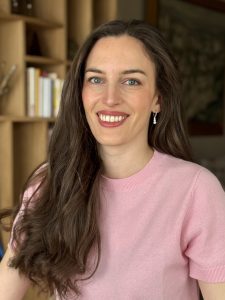
Where are you from?
I’m from a small town called Aarau in the German-speaking part of Switzerland.
What sparked your interest in Economics, and what led you to pursue your M.A. at Columbia?
During my undergrad at the University of Zurich, where I studied Economics and Mathematics, I took a class with Professor Ernst Fehr, who introduced me to Behavioral Economics, which ignited my passion for the field.
I loved that in behavioral economics models don’t solely rely on the idea of homo economicus but instead attempt to capture how people actually behave, with all their biases, emotions and imperfect judgment. I found that this human lens made economics far more interesting to me. From there, I went on to pursue experimental research in the field and later worked in behavioral economics consulting during and after my undergraduate studies.
I knew I wanted to continue my education beyond that because there were still so many research areas in economics that I wanted to explore and understand better. I am curious and driven by nature, so a master’s degree felt like the natural next step. As for why I chose New York, I had already lived here before, during my previous career as a fashion model, and I knew how much I loved the city. That’s what then led me to pursue this master’s at Columbia University.
Can you tell us a bit about your current role, and your upcoming transition to wealth management?
I currently work as Director of Risk at the fintech firm Fund Studio, which provides portfolio and risk management solutions to hedge funds. I joined during a particularly exciting and entrepreneurial phase, when we partnered with a hedge fund to build a joint risk management system from the ground up. I sat at the intersection of risk management, technology and business development, which gave me exposure to different teams. What I loved most was that I got to learn from and work alongside brilliant risk managers and quants and translate their models in a way so that developers could implement them and potential clients understand them. It was this very collaborative and intellectually nourishing environment that fueled me. Over time, I took on broader responsibilities and became the primary point of contact for our largest global macro hedge fund client.
As of this month, I’ll be joining the Wealth Management team of Vontobel SFA, a Swiss private bank, here in New York, where I’ll focus on growing the New York and Northeast market for the firm. I am excited to build on the relationship-driven side of my work, which I’ve enjoyed so much in my previous job, and create long-term investment opportunities for US investors.
As your fellow students who follow finance know, it’s a particularly interesting time to be in markets. Many US investors are currently seeking to diversify beyond traditional US-heavy investment portfolios and towards more international exposure, and this is exactly where Swiss wealth management shines. Because of this, I feel that the timing has been working out perfectly for me to make this switch, joining a team that is looking to grow by connecting US investors to Swiss financial expertise.
How did your experience at Columbia shape your academic or professional path?
I took away a couple of important learnings from my Columbia education. First and foremost, the formal education gave me a very strong quantitative foundation with which to think about problems I come across in my professional life. In particular, I use a lot of what I learned from our Financial Economics and Econometrics classes regularly in my work today.
Second, my time at the university gave me a structured way of thinking: it taught me more about how to approach problems systematically, which is a great tool with which to tackle challenges in general, and allowed me to build on the frameworks I had begun developing in my undergrad. That, which is more of a mindset than any specific know-how or tool, has been serving me well professionally.
And third, Columbia gave me a great community. Many of the people with whom I studied are now close friends and accomplished professionals across industries. Being surrounded by these individuals was incredibly valuable for me, and it continues to inspire me and shape my life today.
Were there any professors, courses, or experiences that especially influenced your interests or career direction?
I greatly enjoyed the Financial Economics class I took with Professor Steven Ho, and it’s directly relevant to my work today. I also took Professor Bernard Salanié’s Advanced Micro class, which infamously was very challenging, but incredibly rewarding from a learning perspective.
During my last semester I was also a teaching assistant in Financial Economics for undergrad students, and I really loved that experience. It exposed me to a different student body, and I of course also got even more familiar with the material. Overall, it was a very nurturing experience to teach and to see how courses are taught at a different university.
I wouldn’t say any single course or experience directly determined my decision to go into risk or wealth management, but they gave me strong analytical tools and ways of thinking that I use every day. At the end of the day, our master’s is also what one makes of it. Students who pursue our master’s in economics can pivot into so many different fields, and it’s really more about what you are passionate about and which direction your curiosity and drive take you.
Being in New York City offers unique opportunities; how did you take advantage of the city’s resources and networking opportunities during your time at Columbia?
This was one of my favorite parts of being at Columbia University.
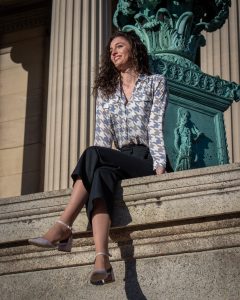
I had moved to New York not knowing anyone, so I had to build friendships and a community from scratch. I studied partly during Covid, when the campus was often empty, so whenever I saw another student, I would quite literally introduce myself and suggest grabbing lunch. Some of those spontaneous hallway conversations have over time turned into deep friendships that continue to this day, and it was often also with people from completely different programs.
Professionally, I made a conscious effort to create opportunities and build a sustainable network. I attended as many career events as possible, connected, reached out to people whose careers I admired, and asked for coffee chats or advice.
I also sought exposure beyond our program. For example, I connected with students at Columbia Business School and attended their career talks whenever possible. If there was a door leading to an opportunity out there, I tried to open it. It doesn’t always work, but it’s important, especially in such a competitive environment, to put yourself out there and take initiative.
What advice would you share with current students who are hoping to follow a similar path?
Try to create opportunities for yourself: boldly reach out to people and ask them for advice, for coffee chats or simply ask them questions and try to learn from their experiences.
Also, and I know this might sound cliché, but try to enjoy this time as much as possible. All the coursework can be intense, but these are also incredibly special, formative years. You are surrounded by fantastic and very smart people in an environment built for learning. We are very fortunate to be in this position, so seize it to the fullest. Take full advantage of every resource available to you.
And travel – you won’t have as much time anymore once you start working.
Finally, and perhaps most fundamentally: stay curious and driven, and always keep learning.
